

- February 18, 2026
- Rupesh Patel
7 Ways to Turn WhatsApp Into Your Best SalesChannel
Most Indian SMBs already close deals on WhatsApp. A customer asks about pricing, your sales rep sends avoice note, negotiations happen over chat, and someone eventually sends a Razorpay link. It works —sort of. But 47% of WhatsApp messages arrive outside office hours, which means nearly half your opportunities sit unread until the next morning. And your competitors? They’re replying in minutes, not hours.
The problem isn’t WhatsApp. WhatsApp is where your customers already are. The problem is that you’re
using a consumer chat app to run business operations, and it’s costing you deals every week.
This isn’t a list of vague suggestions. Each of the seven upgrades below comes with a specific payoff —
measured in time saved, revenue gained, or problems eliminated. You don’t need all seven at once. Pick the one that solves your biggest problem and start there.
Related reading: Why Slow WhatsApp Replies Cost Indian SMBs ₹14 Lakh a Year
Upgrade 1: Analytics That Show You What’s Actually Happening
Your team answered 847 messages last week. How many led to a sale? Which rep was fastest? What time
gets the most inquiries? How many messages sat unanswered for 30+ minutes?
Most teams can’t answer a single one of those questions. They’re making staffing decisions, performance reviews, and strategic choices based on gut feeling — because they simply can’t see the numbers.
An analytics dashboard surfaces this automatically. Response time by rep — average, fastest, slowest.
Conversations by status. Lead sources that actually convert versus the ones that waste your team’s time.
Peak hours so you know when to add coverage
One retail team in Chennai discovered that 40% of their inquiries came between 6 and 8 PM. They had zero coverage after 5. They added one evening rep. Conversions jumped 28% the following month.
The data was already there. They just couldn’t see it before
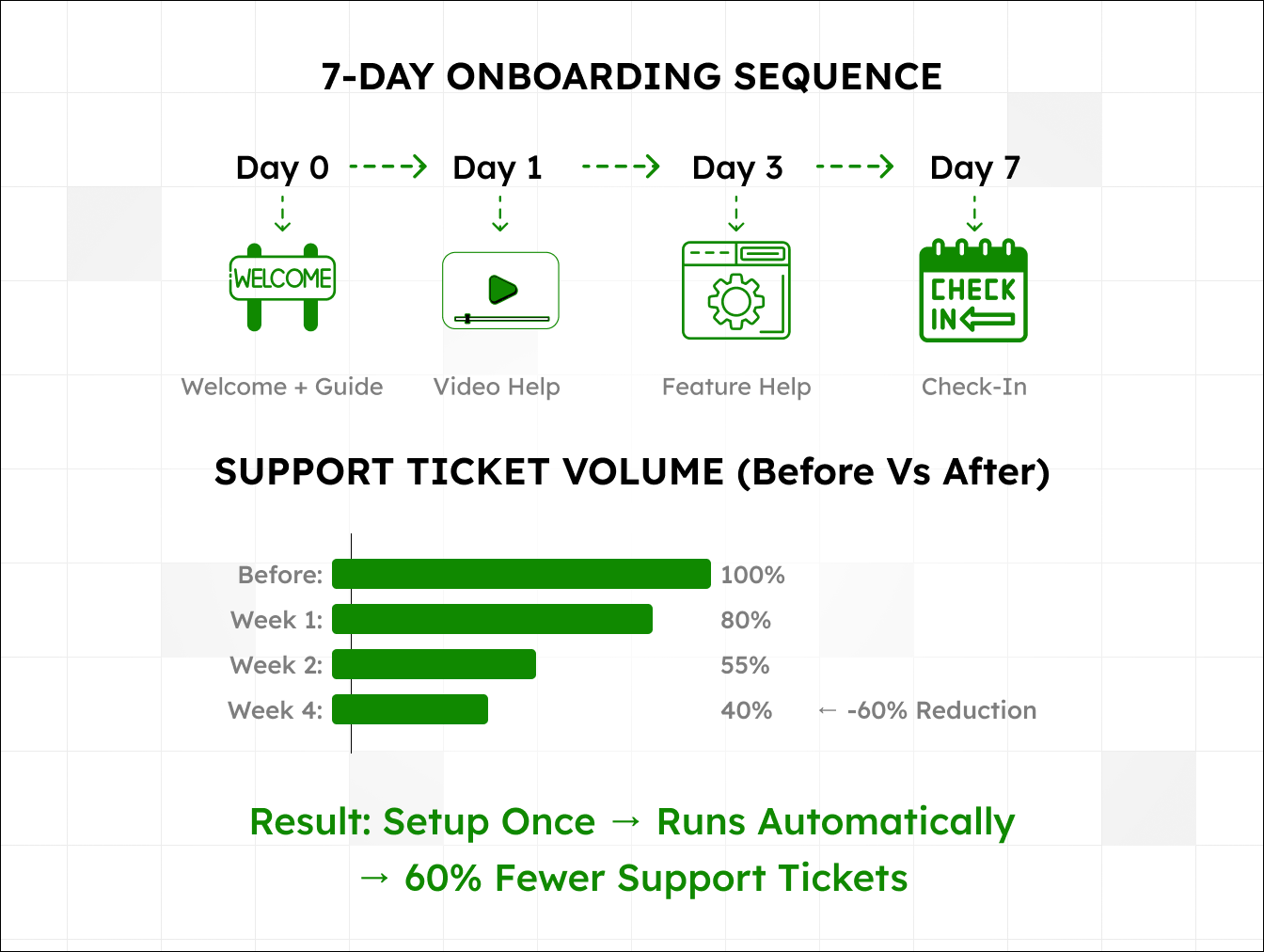
Upgrade 2: A 7-Day Onboarding Sequence That Prevents Churn
New customer signs up. What happens next? For most businesses, the answer is vague — maybe an email, maybe a call in a few days, maybe nothing. And then 30% of those new customers churn within 90 days, often because they never got proper onboarding.
A 4-message WhatsApp sequence over 7 days changes this.
- Day 0 — Welcome message plus a setup guide link
- Day 1 — “Did you complete setup? Here’s a quick video if you’re stuck.”
- Day 3 — “Most customers have this feature running by now. Need help?”
- Day 7 — “Quick check-in. What’s working? What’s not?”
Setup time was 30 minutes. The result one team saw was 60% fewer “how do I…” support tickets.
The difference between a churned customer and a loyal one often comes down to those first 7 days. Not
the product quality, not the pricing — just whether someone bothered to check in.
Diagram 1: 7-Day Onboarding Sequence
Upgrade 3: A Chatbot for the Repetitive 40%
“Hi, what are your prices?” Your team gets this 30 times a day. Each response takes 2 minutes. That’s an
hour daily on one question — a question that has the exact same answer every time.
A rule-based chatbot handles this. Pricing questions get the price list. Store hours get the auto-reply.
Product availability gets checked and sent. Order status gets pulled from the system.
Your reps stay free for complex negotiations, custom requirements, complaints that need a careful
response, and leads ready to close — the stuff that actually needs a human brain.
One retail client automated 40% of incoming messages. Their support team went from 6 reps to 4, and
response time on complex queries actually improved because reps weren’t buried in copy-paste work
anymore. That’s about 20 hours per month saved.
A word of honesty here: chatbots are bad at nuance. They struggle with upset customers, unusual requests, and anything that requires judgment. The goal isn’t to replace your team — it’s to filter out the repetitive 40% so humans handle the 60% that matters.
Upgrade 4: Team Visibility So Nobody Steps on Each Other
Customer messages at 2 PM. Rep A reads it at 215, gets pulled into a call, and forgets. Rep B sees it at 3
PM, doesn’t know if someone’s handling it, assumes yes, and moves on. Customer waits. By 5 PM they’ve
messaged your competitor.
This happens more than teams realize. Not because reps are bad, but because personal WhatsApp gives
zero visibility into who’s doing what.
A shared inbox shows all conversations in one view. Chats get assigned to specific reps. You can see when someone’s typing in real-time. If someone’s stuck, another rep jumps in. If someone’s overloaded, the manager redistributes.
No more “I thought you had it.” Clear ownership and instant handoffs mean zero dropped conversations.
Upgrade 5: CRM Integration That Saves 3 Hours Per Day
Your CRM says the lead is “Interested.” WhatsApp shows the last message was 3 weeks ago. Your
spreadsheet says the deal closes “this month.” Three systems, three different stories.
When your WhatsApp syncs with your CRM, a new message auto-creates the contact. Conversation gets
tagged to the deal. The rep sees full history in one view — no switching tabs, no copy-pasting customer
names, no stale data.
We measured this with one team. Before integration, their reps spent 4 minutes per conversation on admin work — opening the CRM, searching for contacts, updating notes. 50+ conversations a day meant over 3 hours lost to tab-switching. After integration, the same 50 conversations took 25 minutes total. That’s 8x faster per chat and 2+ hours returned to each rep every single day.
Upgrade 6: Mobile CRM — Reply From Anywhere
Your top sales rep is in a cab. A lead messages, ready to buy. Without mobile access, the rep says “I’ll
check when I’m at my desk.” Two hours later, the lead bought from someone who actually responded.
Remember that 47% stat? Nearly half of business WhatsApp messages arrive outside office hours. If your team can only respond from a desktop, you’re invisible for almost half the day.
A mobile CRM gives your reps the same inbox, same contact history, same templates, and real-time sync
between phone and desktop. One rep closed a ₹2.3 lakh deal from a hospital waiting room because he
could pull up the full conversation history and send a template quote in under a minute.
The office isn’t where deals happen anymore. Deals happen wherever your phone has signal
Upgrade 7: Broadcasts That Actually Make Money
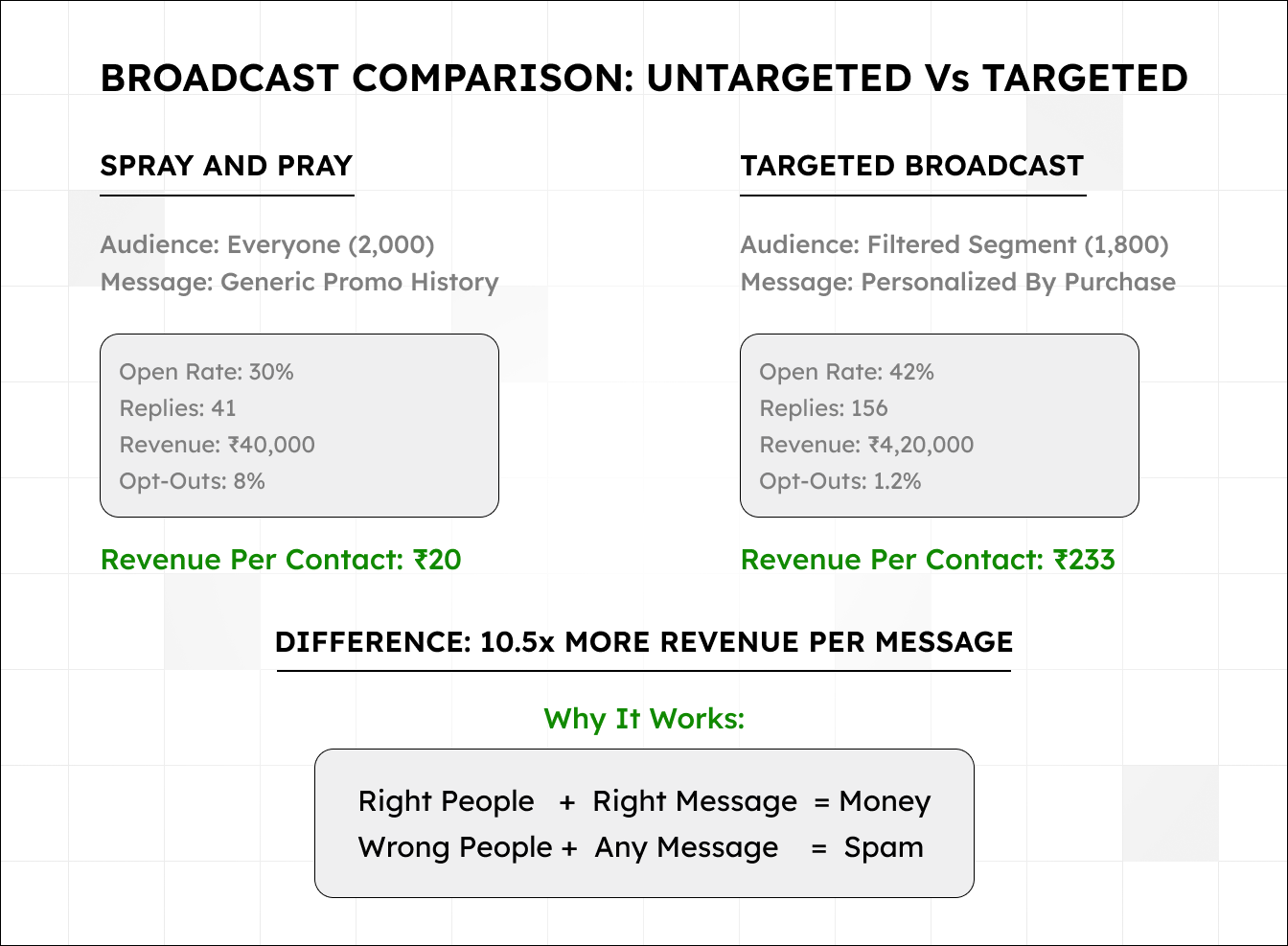
You have 2,000 contacts. Sending each one a message individually would take 40 hours of copy-paste. Or
you could do it in 30 seconds.
Broadcasts work in three steps. Build your segment — customers who bought in the last 30 days, leads
tagged “interested” who didn’t convert, contacts in a specific city. Pick a pre-approved WhatsApp template and personalize it. Hit send.
Real numbers from businesses who’ve done this.
- One product launch reached 3,200 contacts — 42% open rate, 156 direct replies, 23 orders within 24 hours
- One festival sale announcement went to 1,800 contacts — 38% open rate, ₹4.2 lakh revenue from a single message
The compliance piece matters here. WhatsApp has strict rules — templates need approval, you can only
message contacts who opted in, and spamming gets your account banned. Do it right and broadcasts
generate real revenue. Do it wrong and you lose your number. There’s no middle ground.
Diagram 2: Spray and Pray vs Targeted Broadcast
Where to Start
You don’t need all seven upgrades running by next Monday. That would be overwhelming, and most of them wuldn’t stick.
Pick the one that matches your biggest pain right now.
- Leads going cold? Start with Upgrade 1 (analytics) to see where the gaps are, then Upgrade 4 (team visibility) to close them
- Reps drowning in repetitive questions? Start with Upgrade 3 (chatbot) to free up their time
- No clue what happens outside office hours? Start with Upgrade 6 (mobile CRM)
- Have a big contact list gathering dust? Start with Upgrade 7 (broadcasts) for quick revenue
Each upgrade builds on the others. Analytics show you the problem, the team inbox fixes the structural
issues, automation handles the volume, and broadcasts turn your contact list into revenue. But you can
start with any one of them and see results within the first week.
Once your sales are flowing, build the system to keep them flowing: From Cold Leads to Closed Deals: A
WhatsApp Follow-Up System
Start a free trial and pick your first upgrade. Or book a demo and we’ll help you figure out which one to
prioritize.